Showing posts with label standards. Show all posts

Monday, October 1, 2018

Reflections - Chapter 3 - Standards in Early Childhood Education

Standards in Early Childhood Education 

https://browardschools.instructure.com/

Let's first analyze the situation in the United States: 

In US early childhood education there is no permanent system of annual information collection at national level that registers the development of children under 5 years of age. There are specific evaluation research institutions and specialized institutions that offer early childhood education services and include evaluation processes, for example: The Institute of Education Sciences (IES), the Institute of Health and Human Services (IHHS). Human Services Research Institute (HSRI), and the Office of Early Childhood Development, among others. These institutions began to work in a more coordinated way, however a more accurate system of coordination is required, that is why the author proposed a system based on standards for Early Childhood Education. 

At state level, all the US states evaluate their children when they enter school. Monitoring and permanent reports of achievements in the programs are used, including the goals achieved or those in process. 

In the article some Early Childhood programs are mentioned like Head Start. It is a national program, it depends on the Department of Health and Human Services of the United States. It includes education, health and family support, and serves children in poverty with ages from 3 to 4 years. Education in this program includes teacher qualification standards, curriculum and assessment, cultural relevance and language and other standards to promote school readiness. Besides, they help family engagement and support that consists of the promotion of parent-child relationships, support for family well-being, promotion of leadership and links with community resources. Their data is collected through an annual program report, which reports on the services provided, a survey of experiences of families and children with programs of services and achievements of children, who are evaluated three times a year to help adjust and validate the program, using various instruments. 

To cover children from prenatal to 3 years, Early Head Start was created. Federally funded by the United States government and targeted to low-income families with pregnant women or young children. EHS promotes healthy prenatal experiences in pregnant women, facilitates good development in young children and promotes healthy habits to families. The EHS Evaluation and Research project was designed to support the continuous improvement of the program, so it became a rigorous and large-scale activity. It included the phase from birth to 3 years (1996-2001) including implementation, impact evaluation and local research projects. 

· The Kindergarten phase (2001-2004), used the data from the first phase and developed the follow-up of the children. 

· The primary school phase (2005-2010) followed the children from the results of the first two phases. 

The article deals with the issue of the implementation and use of standards and their evaluation in early childhood as an inherent component of educational activities and political decisions. Besides, it presents a theoretical framework that reviews the background and trends of the evaluation in order to start from a base. The topic was approached from a systemic approach that involved considering all the components of the education system that influence the integral development and learning of children. This quality system of standards must consider the analysis, observation, feedback and evaluation not only of the child's learning and development, but also of the context, school management and policies, teaching performance and the curriculum, as well as the impact of the programs and services, all with the aim to give feedback to the system and allow to direct efforts towards the continuous improvement of the processes and, thereby, achieving better results. 

Currently, the use of standards has become relevant both in the academic and in the political sphere, giving rise to the emergence of new approaches and approaches. For this reason, it is important to highlight the analysis made in the article of the evolution that this concept has had throughout history. In this way we can verify that this term was born in the industrial field. Its implementation is used to determine the level or degree of quality or level achieved using the standards as a assessment tool. In education, its use is promoted not to only assist to student performance, but also to get other components involved such as teachers, educational materials/resources, curriculum, activities, methodology, organization, infrastructure, policies, among others. 

However, the difficulty of agreement to organize them into a joint system for an appropriate and regulated standards-based child education is highlighted. Even though significant advances and initiatives have been made with different strategies for the design of a system of standards for the integral development and learning of children, there is still a lack of strategies and instruments for monitoring and assessing other components of the system. 

Why to establish a system of standards for early childhood education? 

According to the article, the process of implementing standards in early childhood education is considered as a research process that requires the participation of all the education professionals and their contribution for its permanent improvement. It is through action research that the teacher has the opportunity to reflect on the methods and become aware of their achievements and difficulties, thus allowing the introduction of necessary modifications and adjustments for the improvement of the quality of education. 

It refers to the explicit formulation of expectations about what children should know and know how to do as a result of their learning and development in various domains: motor, cognitive, socio-emotional, language and literacy and attitudes towards the learning. Some call them "milestones", others "orientations", others "desired results". As stated by S. L. Kagan (2007), the denomination of standard generates controversy, since it confuses the fact of having "expectations for all children" with the idea of ​​homogenizing children and losing sight of the richness of diversity. 

For its part, "Kagan and Britto (2005), suggest that early learning standards can be considered as an "elixir" that can be used for various purposes: 

• Improve teaching: can serve as a basis to review existing educational programs according to the needs of children. 

• Improve parental skills and behaviors: they can be used to design materials that help parents see what is realistic to expect of their children and how to teach them at home. 

• Develop screening tests: they can provide the contents to be included in screening tests that assess the overall level of child development. 

• Improve the education of educators: they can guide the design of professional development for educators, providing information about what teachers should know and be able to do in their teaching role. 

• Evaluate the effectiveness of programs: they can serve as a basis for selecting or developing instruments for assessing children's development, as part of a comprehensive evaluation of the effectiveness of programs aimed at children. 

• Monitor the progress of children and families at the national level: they can be used to collect data on achievements in children's learning that inform progress at the country level, through sample evaluations. 

• Improve public knowledge about child development: they can be used to design dissemination materials for the general public, or for new fathers and mothers. 

This commitment to create and design a system for equity and quality responds to the recognition of the importance of the first years of life for human development and, for this reason, Kagan shows her interest in promoting and exploring research related to development in the early stages and to disseminate its results in order to influence the formulation of adequate policies for children. The article invites the reader and all members of the child education community to review the system (including methodological approaches), as well as to monitor programs, policies, services, development and learning of children to create a consensus. 

Some recommendations were made, some of the most relevant are: to strengthen the standard systems with the health, education and social assistance sectors and others; to collect, disseminate and exchange successful experiences on strategies, formulation of indicators, standards and assessment instrument; to perform longitudinal studies and to promote public forums on the subject; to assign social, human and economic resources necessary to carry out the monitoring and follow-up of all the components of the education system; to incorporate parents in the management of the center or program. 

For this the standards must be organized in four categories: 

- Utility understood as the need for standards to be informative, timely and have the ability to influence. To achieve this, those responsible for carrying it out must draw up their designs based on the information needs detected and clearly communicate the required information to those who have requested it. 

- Feasibility is related to financing and in this sense, it states that they should not consider more resources, materials, personnel or time than necessary to carry out the evaluation. 

- Legitimacy aims to protect the rights of the people affected by the evaluation by informing about the illegal, unethical and incompetent actions of those who carry out the evaluations. Within the framework of the rights of individuals, it is sought that the evaluators know and respect the laws on privacy, freedom of information and the protection of human rights. 

- Precision is an attribute that refers to the quality of the evaluation, if the information presented is technically adequate, comprehensive, which allows to assess the merit of the program. In addition, the judgments issued must have a logical relationship with the data. 

References:

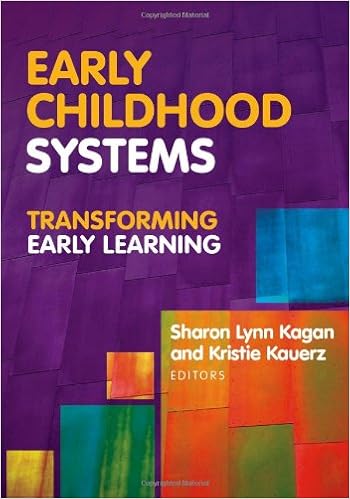
  • Kagan, S. & Kauerz, K. (eds.) (2012). Early Childhood Systems: Transforming EarlyLearning. New York: Teachers College Press. 

Notes - Early Learning and Development Standards


Early Learning and Development Standards

An Elixir for Early Childhood Systems Reform

Sharon Lynn Kagan


I want to share some important information from this chapter.

Well recognized in her work the consideration of early childhood development and education as a multilingual and multicultural development and learning for young children. There is a big issue that defines the Early Childhood system, compared to other K-12 grades, its inconsistency in pedagogy, professional development, policies, among many others. But when putting all together into harmony, it turns into a disorganized symphony with many different voices and different melodies.

“The chapter suggests that early learning and development standards can and should be used to create an integrated pedagogical subsystem that forms the basis for a comprehensive, well-articulated early childhood system”.

The ubiquity and utility of standards
The standards determine adequacy or quality, secure agreement of importance, and according to the level reached give you a category or status. They can not be only found in K-12 grades, but they are included in our lives too such as the economic, health, social values,… Standards can also help us improve the processes and ensure protection and safety. Standards, in essence, provide a means of understanding and expressing commonalities. However, standards can reduce liberties and impose constraints, retraining creativity and limiting variations.

K-12 Educational Standards
During the 20th century the standards became entrenched and imposed, its purpose to guarantee professionalism and effectiveness, influenced by economy and industry (productivity standards for employee performance and for product outputs). As a response for the lack of creativity and other educational levels, some pedagogics tried to establish a curriculum that focused on creative thinking that could cover the content area of the subjects as well as the learning skills, processing and application of knowledge.

In its process of implementation of standards, they became very important in dealing with equity and quality. During the late 1980s and 1990s the US government established national goals for American students, but later its controversy came up regarding its meaning.

Advantages of Educational Standards
One of the biggest advantages that we can find in educational standards are:

- their clarity of what is taught and learned (Jennings, 1995) with content and higher order thinking skills.

- Creation of platform for more equitable approaches to education, they ensure that all students have access to challenging content promoting equity.

Disadvantages of Educational Standards


Some concerns are that they can promote inequity since they can undercut the potential of the education system. Besides, high standards can cause underachievement and as a consequence student drop out exacerbating the equity divide. Even the standards for assessment cannot help reducing the equity gap.

Some concerns about its setting and control (Darling-Hammond, 1994) depending on the ideals and concepts of education can be difficult in determining standards, others define them as the representation of the canons of the professions set by those most familiar with the disciplines. Controversy exists when dealing with the establishment of standards: national versus state, politicians versus education professionals.

Some concerns regarding teachers, administrators, schools, districts, and governments (Darling-Hammond, 1994), for example the selection of standards by teachers and the teachers´ decision to teach for a test (drill and kill pedagogy). Standards help organize pedagogy, teachers needs professional development.

Some fiscal concerns, since standards need funds to be established, implemented and monitored. And according to school performances they get more or less money with the consequently effect on resources.

Early Childhood Standards

As in K-12, standards became entrenched and more normative in early education (Kagan & Scott-Little, 2004), the standards movement brought dramatic changes to early education too.

From the pedagogical perspective, early educators have long been taught to take their instructional and curricular cues from young children. Children´s interests serving as the basis for eliciting motivation and a natural inclination toward learning.

From the policy perspective, an equally persuasive position prevailed. Considered as a private affair involving those closest to the children who understood their needs best. Besides, most of EC programs functioned as almost autonomous entities. The idea of governments creating a set of standards on early education directly opposed early childhood principles of localism, autonomy, and privatization.

Pedagogical History
Explicit early learning standards did no exist.

- Rousseau (1762), his goal of early education was to preserve the natural state of the child through play.

- Pestalozzi, opponent of memorization, advanced the “standard” that the best learning happened through doing.

- Froebel (mixing Rousseau and Pestalozzi) father of kindergarten movement, respected the role of children in constructing their learning, promoting hands-on learning activities.

- Owen and Malaguizzi (with Froebel) strong believers of child-play instruction (Wolfe, 2002)

Policy History

Early childhood education was traditionally considered as a competence of the home. Families could choose the education of their young children – culture of the home (Greenfield, 1994; LeVine, 1974). There is no consensus, and the decisions differ from one families to others based of their culture and their idea of child development (Hofstede, 1980; Holloway, 2000; Markus & Kitayama, 1991; Tobin, Wu, & Davidson, 1989). Diversity and choice, aside from the costs of the fees.

Never seen before from a policy perspective, early education has always been related to social needs, and political, social and economic challenges. As a result, American early education appeared as a two-track system, with one approach for serving the poor and one for middle/upper-class children (Cahan, 1989; Tank, 1980). Consequently, due to the disparity in resources, the concept of intention of learning varied as well. It is translated into an incoherent approach to early education, diversity of local programs with their own characteristics.

The contemporary status of standards.
K-12 grades Standards are used in all 50 states and accepted component of education. No Child Left Behind Act (NCLB) – funds to test grades 3, 8 and 10. Controversy: the next reauthorization of ESEA – recommendations for reform are numerous and range from complete abolition to modification (Finn, Julian, & Petrilli, 2006) – Federal government impose standards on the states and these be used for accountability (Barton, 2009).

Common standards for K-12 are surging forward (Klein, 2009) By establishing them, the education system in the US could deal with and help diversity, an immense challenge. Two issues regarding standards:
  • Philosophical, it´s responsible for student achievement. Institution: standards and testing regimes make schools responsible. Learning takes place beyond the schoolhouse doors.
  • Implementation of standards and concerns the accommodation of differing approaches to instruction, the nature and ability of assessments to capture higher order skills, and the development and implementation of incentives that will improve outcomes, not simply punish poor-performing students or schools.

EC standards
Every state has EC standards or guidelines for preschool-aged children (Scott-Little, Kagan, Frelow, & Reid, 2009). Language and math are the two main domains – covering a single age group (36-48 months), nowadays they embrace birth to 5.

Another standard movement – the alignment of preschool standards with other EC documents (Scott-Little, Kagan, Frelow, & Reid, 2009). States are aligning their standards with those that exist in K, and in grades 1 through 3, thus promoting continuity through the primary years of schooling. To ensure linkages between those developed for infants and toddlers and those developed for preschoolers. Some states ensure that multiple sets of standards for a single age group are aligned. Standards also are being aligned with curriculum and assessments. Some consideration is being given to the desirability and feasibility of developing common standards.


A suggested approach
Should standards become national and how can standards be used most effectively to improve student performance?

These preoccupations about EC standards implementation are somewhat ill-placed. They have to consider the multiple dimensions and uses of standards, as well as their potential to bring EC pedagogy and early learning systems into alignment.

UNICEF developed an integrated approach to standards implemented globally with some success (Kagan & Britto, 2009). Conceptually, the work advances the understanding that what children should know and be able to do is at the core of the early childhood enterprise.

Based on clear definitions or standards:

a) Teachers can be taught what and how to teach, thereby forming the basis of teacher education and, consequently, certification;

b) Parents can be guided in what to expect from their children at particular ages, thereby guiding the development of parenting support and education efforts;

c) The public can be made aware of appropriate expectations for children, forming the basis for public information efforts;

d) Curricula that are age and content appropriate can be developed, thereby guiding content developers and textbook publishers, along with local curriculum design efforts;

e) Checklists that chronicle children´s progress can be developed, thereby improving the individualization of teacher practice;

f) Items from the standards, once subjected to item analysis, can be selected for state or national monitoring

g) Data can be used for program evaluation and for the planning of inservice technical support for teachers.

Standards may be used to align disparate elements of early care and education and other systems (Kagan & Kauerz, 2007; O´Day & Smith, 1993).

Standards for students can drive what teachers should know and be able to teach, thereby influencing the content of teacher preparation and potentially even teacher certification (Kagan, Kauerz, & Tarrant, 2008)

Standards have the potential to align what is expected of students and what is taught by their teachers.

Standards serve as the basis for assessment, aligning what is expected, what is taught, and what is assessed (Egertson, 2008; Kagan & Britto, 2009; Schultz, 2008). Summing up, STANDARDS can serve as the PIVOT around which early childhood pedagogy rotates. By using standards for these multiple purposes, and integrated approach to early ECE and development, one that unites what children are expected to know and be able to do, and what their parents and teachers can and should do to support their development. – Integrated approach also links what children are taught to the content of the assessment and to the national reports that give evidence of progress.

Using the consensually developed standards as the base, all these elements are integrated so that what children are taught comports with what they are tested on, how their teachers are trained, and how their programs and policies are evaluated and monitored.

The process puts children and their needs at the center of policy efforts. By impacting teacher training, parenting education, instruction, curriculum, and even national monitoring and evaluation, early learning standards can be the glue that integrates diverse activities and aspects of the field.


The Utility of the Approach
Seeing other countries, it highlights the potential of standards to enhance multiple components of EC development, and thereby shifts the conversation regarding standards, that are regarded as useful to creating an integrated approach to EC pedagogy. The multiple-use approach to standards is grounded in the mores of those who create them, so that they reflect the goals, values, and desires that adults hold for their children.

Some successful examples in the world of its implementation: Ghana where the standards have been used as the basis for curriculum development as well as teacher training and credentialing. In Fiji and Mongolia supplied a foundation for the development of parenting education curricula, and in Romania, the basis for public information campaign.

Standards = guidelines, because standards are seemed as “government imposition of rules”.

Concerns regarding the use of standards with highly diverse in the form of variability in ethnicity, religion, geography, tribe, language, and ability populations within a giving country. Accommodations have been made to embrace all children. Some countries prioritize the uses within a plan for near-term and more long-term implementation. 


Implications of the Approach for System Building
They need to have all the pieces of the puzzle to work to render a system whole. While attention has been accorded pedagogy, less has been accorded the development of a pedagogical subsystem, that´s why it´s so important to develop a subsystem with early learning and standards at is core. They will be the intellectual foundation for curriculum, teacher PDs…

American early education is missing the boat in terms of how we use standards. Pedagogically integrated systems are not only within our reach but must sit at the core of all systems development efforts. Implemented well and widely, they are the essential systems elixir. 

Kagan, S. & Kauerz, K. (eds.) (2012). Early Childhood Systems: Transforming EarlyLearning. New York: Teachers College Press.