Showing posts with label PhD. Show all posts

Monday, October 1, 2018

Reflections - Chapter 3 - Standards in Early Childhood Education

Standards in Early Childhood Education 

https://browardschools.instructure.com/

Let's first analyze the situation in the United States: 

In US early childhood education there is no permanent system of annual information collection at national level that registers the development of children under 5 years of age. There are specific evaluation research institutions and specialized institutions that offer early childhood education services and include evaluation processes, for example: The Institute of Education Sciences (IES), the Institute of Health and Human Services (IHHS). Human Services Research Institute (HSRI), and the Office of Early Childhood Development, among others. These institutions began to work in a more coordinated way, however a more accurate system of coordination is required, that is why the author proposed a system based on standards for Early Childhood Education. 

At state level, all the US states evaluate their children when they enter school. Monitoring and permanent reports of achievements in the programs are used, including the goals achieved or those in process. 

In the article some Early Childhood programs are mentioned like Head Start. It is a national program, it depends on the Department of Health and Human Services of the United States. It includes education, health and family support, and serves children in poverty with ages from 3 to 4 years. Education in this program includes teacher qualification standards, curriculum and assessment, cultural relevance and language and other standards to promote school readiness. Besides, they help family engagement and support that consists of the promotion of parent-child relationships, support for family well-being, promotion of leadership and links with community resources. Their data is collected through an annual program report, which reports on the services provided, a survey of experiences of families and children with programs of services and achievements of children, who are evaluated three times a year to help adjust and validate the program, using various instruments. 

To cover children from prenatal to 3 years, Early Head Start was created. Federally funded by the United States government and targeted to low-income families with pregnant women or young children. EHS promotes healthy prenatal experiences in pregnant women, facilitates good development in young children and promotes healthy habits to families. The EHS Evaluation and Research project was designed to support the continuous improvement of the program, so it became a rigorous and large-scale activity. It included the phase from birth to 3 years (1996-2001) including implementation, impact evaluation and local research projects. 

· The Kindergarten phase (2001-2004), used the data from the first phase and developed the follow-up of the children. 

· The primary school phase (2005-2010) followed the children from the results of the first two phases. 

The article deals with the issue of the implementation and use of standards and their evaluation in early childhood as an inherent component of educational activities and political decisions. Besides, it presents a theoretical framework that reviews the background and trends of the evaluation in order to start from a base. The topic was approached from a systemic approach that involved considering all the components of the education system that influence the integral development and learning of children. This quality system of standards must consider the analysis, observation, feedback and evaluation not only of the child's learning and development, but also of the context, school management and policies, teaching performance and the curriculum, as well as the impact of the programs and services, all with the aim to give feedback to the system and allow to direct efforts towards the continuous improvement of the processes and, thereby, achieving better results. 

Currently, the use of standards has become relevant both in the academic and in the political sphere, giving rise to the emergence of new approaches and approaches. For this reason, it is important to highlight the analysis made in the article of the evolution that this concept has had throughout history. In this way we can verify that this term was born in the industrial field. Its implementation is used to determine the level or degree of quality or level achieved using the standards as a assessment tool. In education, its use is promoted not to only assist to student performance, but also to get other components involved such as teachers, educational materials/resources, curriculum, activities, methodology, organization, infrastructure, policies, among others. 

However, the difficulty of agreement to organize them into a joint system for an appropriate and regulated standards-based child education is highlighted. Even though significant advances and initiatives have been made with different strategies for the design of a system of standards for the integral development and learning of children, there is still a lack of strategies and instruments for monitoring and assessing other components of the system. 

Why to establish a system of standards for early childhood education? 

According to the article, the process of implementing standards in early childhood education is considered as a research process that requires the participation of all the education professionals and their contribution for its permanent improvement. It is through action research that the teacher has the opportunity to reflect on the methods and become aware of their achievements and difficulties, thus allowing the introduction of necessary modifications and adjustments for the improvement of the quality of education. 

It refers to the explicit formulation of expectations about what children should know and know how to do as a result of their learning and development in various domains: motor, cognitive, socio-emotional, language and literacy and attitudes towards the learning. Some call them "milestones", others "orientations", others "desired results". As stated by S. L. Kagan (2007), the denomination of standard generates controversy, since it confuses the fact of having "expectations for all children" with the idea of ​​homogenizing children and losing sight of the richness of diversity. 

For its part, "Kagan and Britto (2005), suggest that early learning standards can be considered as an "elixir" that can be used for various purposes: 

• Improve teaching: can serve as a basis to review existing educational programs according to the needs of children. 

• Improve parental skills and behaviors: they can be used to design materials that help parents see what is realistic to expect of their children and how to teach them at home. 

• Develop screening tests: they can provide the contents to be included in screening tests that assess the overall level of child development. 

• Improve the education of educators: they can guide the design of professional development for educators, providing information about what teachers should know and be able to do in their teaching role. 

• Evaluate the effectiveness of programs: they can serve as a basis for selecting or developing instruments for assessing children's development, as part of a comprehensive evaluation of the effectiveness of programs aimed at children. 

• Monitor the progress of children and families at the national level: they can be used to collect data on achievements in children's learning that inform progress at the country level, through sample evaluations. 

• Improve public knowledge about child development: they can be used to design dissemination materials for the general public, or for new fathers and mothers. 

This commitment to create and design a system for equity and quality responds to the recognition of the importance of the first years of life for human development and, for this reason, Kagan shows her interest in promoting and exploring research related to development in the early stages and to disseminate its results in order to influence the formulation of adequate policies for children. The article invites the reader and all members of the child education community to review the system (including methodological approaches), as well as to monitor programs, policies, services, development and learning of children to create a consensus. 

Some recommendations were made, some of the most relevant are: to strengthen the standard systems with the health, education and social assistance sectors and others; to collect, disseminate and exchange successful experiences on strategies, formulation of indicators, standards and assessment instrument; to perform longitudinal studies and to promote public forums on the subject; to assign social, human and economic resources necessary to carry out the monitoring and follow-up of all the components of the education system; to incorporate parents in the management of the center or program. 

For this the standards must be organized in four categories

- Utility understood as the need for standards to be informative, timely and have the ability to influence. To achieve this, those responsible for carrying it out must draw up their designs based on the information needs detected and clearly communicate the required information to those who have requested it. 

- Feasibility is related to financing and in this sense, it states that they should not consider more resources, materials, personnel or time than necessary to carry out the evaluation. 

- Legitimacy aims to protect the rights of the people affected by the evaluation by informing about the illegal, unethical and incompetent actions of those who carry out the evaluations. Within the framework of the rights of individuals, it is sought that the evaluators know and respect the laws on privacy, freedom of information and the protection of human rights. 

- Precision is an attribute that refers to the quality of the evaluation, if the information presented is technically adequate, comprehensive, which allows to assess the merit of the program. In addition, the judgments issued must have a logical relationship with the data. 

References:

  • Kagan, S. & Kauerz, K. (eds.) (2012). Early Childhood Systems: Transforming EarlyLearning. New York: Teachers College Press. 

Notes - Early Learning and Development Standards


Early Learning and Development Standards

An Elixir for Early Childhood Systems Reform

Sharon Lynn Kagan


I want to share some important information from this chapter.

Well recognized in her work the consideration of early childhood development and education as a multilingual and multicultural development and learning for young children. There is a big issue that defines the Early Childhood system, compared to other K-12 grades, its inconsistency in pedagogy, professional development, policies, among many others. But when putting all together into harmony, it turns into a disorganized symphony with many different voices and different melodies.

“The chapter suggests that early learning and development standards can and should be used to create an integrated pedagogical subsystem that forms the basis for a comprehensive, well-articulated early childhood system”.

The ubiquity and utility of standards
The standards determine adequacy or quality, secure agreement of importance, and according to the level reached give you a category or status. They can not be only found in K-12 grades, but they are included in our lives too such as the economic, health, social values,… Standards can also help us improve the processes and ensure protection and safety. Standards, in essence, provide a means of understanding and expressing commonalities. However, standards can reduce liberties and impose constraints, retraining creativity and limiting variations.

K-12 Educational Standards
During the 20th century the standards became entrenched and imposed, its purpose to guarantee professionalism and effectiveness, influenced by economy and industry (productivity standards for employee performance and for product outputs). As a response for the lack of creativity and other educational levels, some pedagogics tried to establish a curriculum that focused on creative thinking that could cover the content area of the subjects as well as the learning skills, processing and application of knowledge.

In its process of implementation of standards, they became very important in dealing with equity and quality. During the late 1980s and 1990s the US government established national goals for American students, but later its controversy came up regarding its meaning.

Advantages of Educational Standards
One of the biggest advantages that we can find in educational standards are:

- their clarity of what is taught and learned (Jennings, 1995) with content and higher order thinking skills.

- Creation of platform for more equitable approaches to education, they ensure that all students have access to challenging content promoting equity.

Disadvantages of Educational Standards


Some concerns are that they can promote inequity since they can undercut the potential of the education system. Besides, high standards can cause underachievement and as a consequence student drop out exacerbating the equity divide. Even the standards for assessment cannot help reducing the equity gap.

Some concerns about its setting and control (Darling-Hammond, 1994) depending on the ideals and concepts of education can be difficult in determining standards, others define them as the representation of the canons of the professions set by those most familiar with the disciplines. Controversy exists when dealing with the establishment of standards: national versus state, politicians versus education professionals.

Some concerns regarding teachers, administrators, schools, districts, and governments (Darling-Hammond, 1994), for example the selection of standards by teachers and the teachers´ decision to teach for a test (drill and kill pedagogy). Standards help organize pedagogy, teachers needs professional development.

Some fiscal concerns, since standards need funds to be established, implemented and monitored. And according to school performances they get more or less money with the consequently effect on resources.

Early Childhood Standards

As in K-12, standards became entrenched and more normative in early education (Kagan & Scott-Little, 2004), the standards movement brought dramatic changes to early education too.

From the pedagogical perspective, early educators have long been taught to take their instructional and curricular cues from young children. Children´s interests serving as the basis for eliciting motivation and a natural inclination toward learning.

From the policy perspective, an equally persuasive position prevailed. Considered as a private affair involving those closest to the children who understood their needs best. Besides, most of EC programs functioned as almost autonomous entities. The idea of governments creating a set of standards on early education directly opposed early childhood principles of localism, autonomy, and privatization.

Pedagogical History
Explicit early learning standards did no exist.

- Rousseau (1762), his goal of early education was to preserve the natural state of the child through play.

- Pestalozzi, opponent of memorization, advanced the “standard” that the best learning happened through doing.

- Froebel (mixing Rousseau and Pestalozzi) father of kindergarten movement, respected the role of children in constructing their learning, promoting hands-on learning activities.

- Owen and Malaguizzi (with Froebel) strong believers of child-play instruction (Wolfe, 2002)

Policy History

Early childhood education was traditionally considered as a competence of the home. Families could choose the education of their young children – culture of the home (Greenfield, 1994; LeVine, 1974). There is no consensus, and the decisions differ from one families to others based of their culture and their idea of child development (Hofstede, 1980; Holloway, 2000; Markus & Kitayama, 1991; Tobin, Wu, & Davidson, 1989). Diversity and choice, aside from the costs of the fees.

Never seen before from a policy perspective, early education has always been related to social needs, and political, social and economic challenges. As a result, American early education appeared as a two-track system, with one approach for serving the poor and one for middle/upper-class children (Cahan, 1989; Tank, 1980). Consequently, due to the disparity in resources, the concept of intention of learning varied as well. It is translated into an incoherent approach to early education, diversity of local programs with their own characteristics.

The contemporary status of standards.
K-12 grades Standards are used in all 50 states and accepted component of education. No Child Left Behind Act (NCLB) – funds to test grades 3, 8 and 10. Controversy: the next reauthorization of ESEA – recommendations for reform are numerous and range from complete abolition to modification (Finn, Julian, & Petrilli, 2006) – Federal government impose standards on the states and these be used for accountability (Barton, 2009).

Common standards for K-12 are surging forward (Klein, 2009) By establishing them, the education system in the US could deal with and help diversity, an immense challenge. Two issues regarding standards:
  • Philosophical, it´s responsible for student achievement. Institution: standards and testing regimes make schools responsible. Learning takes place beyond the schoolhouse doors.
  • Implementation of standards and concerns the accommodation of differing approaches to instruction, the nature and ability of assessments to capture higher order skills, and the development and implementation of incentives that will improve outcomes, not simply punish poor-performing students or schools.

EC standards
Every state has EC standards or guidelines for preschool-aged children (Scott-Little, Kagan, Frelow, & Reid, 2009). Language and math are the two main domains – covering a single age group (36-48 months), nowadays they embrace birth to 5.

Another standard movement – the alignment of preschool standards with other EC documents (Scott-Little, Kagan, Frelow, & Reid, 2009). States are aligning their standards with those that exist in K, and in grades 1 through 3, thus promoting continuity through the primary years of schooling. To ensure linkages between those developed for infants and toddlers and those developed for preschoolers. Some states ensure that multiple sets of standards for a single age group are aligned. Standards also are being aligned with curriculum and assessments. Some consideration is being given to the desirability and feasibility of developing common standards.


A suggested approach
Should standards become national and how can standards be used most effectively to improve student performance?

These preoccupations about EC standards implementation are somewhat ill-placed. They have to consider the multiple dimensions and uses of standards, as well as their potential to bring EC pedagogy and early learning systems into alignment.

UNICEF developed an integrated approach to standards implemented globally with some success (Kagan & Britto, 2009). Conceptually, the work advances the understanding that what children should know and be able to do is at the core of the early childhood enterprise.

Based on clear definitions or standards:

a) Teachers can be taught what and how to teach, thereby forming the basis of teacher education and, consequently, certification;

b) Parents can be guided in what to expect from their children at particular ages, thereby guiding the development of parenting support and education efforts;

c) The public can be made aware of appropriate expectations for children, forming the basis for public information efforts;

d) Curricula that are age and content appropriate can be developed, thereby guiding content developers and textbook publishers, along with local curriculum design efforts;

e) Checklists that chronicle children´s progress can be developed, thereby improving the individualization of teacher practice;

f) Items from the standards, once subjected to item analysis, can be selected for state or national monitoring

g) Data can be used for program evaluation and for the planning of inservice technical support for teachers.

Standards may be used to align disparate elements of early care and education and other systems (Kagan & Kauerz, 2007; O´Day & Smith, 1993).

Standards for students can drive what teachers should know and be able to teach, thereby influencing the content of teacher preparation and potentially even teacher certification (Kagan, Kauerz, & Tarrant, 2008)

Standards have the potential to align what is expected of students and what is taught by their teachers.

Standards serve as the basis for assessment, aligning what is expected, what is taught, and what is assessed (Egertson, 2008; Kagan & Britto, 2009; Schultz, 2008). Summing up, STANDARDS can serve as the PIVOT around which early childhood pedagogy rotates. By using standards for these multiple purposes, and integrated approach to early ECE and development, one that unites what children are expected to know and be able to do, and what their parents and teachers can and should do to support their development. – Integrated approach also links what children are taught to the content of the assessment and to the national reports that give evidence of progress.

Using the consensually developed standards as the base, all these elements are integrated so that what children are taught comports with what they are tested on, how their teachers are trained, and how their programs and policies are evaluated and monitored.

The process puts children and their needs at the center of policy efforts. By impacting teacher training, parenting education, instruction, curriculum, and even national monitoring and evaluation, early learning standards can be the glue that integrates diverse activities and aspects of the field.


The Utility of the Approach
Seeing other countries, it highlights the potential of standards to enhance multiple components of EC development, and thereby shifts the conversation regarding standards, that are regarded as useful to creating an integrated approach to EC pedagogy. The multiple-use approach to standards is grounded in the mores of those who create them, so that they reflect the goals, values, and desires that adults hold for their children.

Some successful examples in the world of its implementation: Ghana where the standards have been used as the basis for curriculum development as well as teacher training and credentialing. In Fiji and Mongolia supplied a foundation for the development of parenting education curricula, and in Romania, the basis for public information campaign.

Standards = guidelines, because standards are seemed as “government imposition of rules”.

Concerns regarding the use of standards with highly diverse in the form of variability in ethnicity, religion, geography, tribe, language, and ability populations within a giving country. Accommodations have been made to embrace all children. Some countries prioritize the uses within a plan for near-term and more long-term implementation. 


Implications of the Approach for System Building
They need to have all the pieces of the puzzle to work to render a system whole. While attention has been accorded pedagogy, less has been accorded the development of a pedagogical subsystem, that´s why it´s so important to develop a subsystem with early learning and standards at is core. They will be the intellectual foundation for curriculum, teacher PDs…

American early education is missing the boat in terms of how we use standards. Pedagogically integrated systems are not only within our reach but must sit at the core of all systems development efforts. Implemented well and widely, they are the essential systems elixir. 

Kagan, S. & Kauerz, K. (eds.) (2012). Early Childhood Systems: Transforming EarlyLearning. New York: Teachers College Press.


Tuesday, September 4, 2018

The battle of pyramids in Education: Maslow vs Bloom.

The battle of pyramids in Education and poverty 

Maslow vs. Bloom


Teaching in a "multi-diverse" urban school is different from teaching in a "traditional" class. Let me clarify this concept of "multi-diverse": ethnically, linguistically, and economically diverse heretofore refers to as "multi-diverse". 

In large cities, like Houston, where I live, we can meet people from many different places all over the world. They bring their cultural background with themselves to our city and to the classroom as well. What it could be a very enriching and motivating scenario might turn into a very different experience, I mean adding and including other points of views and perspective to our diverse society is something that we like since it adds more value to us.

In schools, the educational policies and curriculum try to help those students to be immerse in the learning of what they think it could be the best for them: our future citizens. But what happens when there is only one curriculum, one pedagogy for all? Is that the answer for dealing with the diversity in our schools? 

Many schools are facing many problems, but one of the most important ones are the statal tests. Those tests, like STAAR in Texas, will show the educational performace of our schools including teachers, administrators and above all students´ performances in those tests. However, if they´re not listened or cared by the school administrations, they can´t experience only a cultural shock but a removal of their learning basis and be "labelled" as a different student category. This "school experience" can be even worst when they belong to low socioeconomic status families who don´t know how to interact with their school communities. Indeed, the students we teach are often unmotivated, lack of self-confidence and they have to face big challenges at home to succeed in motivation. 

In this article I´ll try to deal with some of the points that affect our urban school students and their challenges.


Maslow - Hierarchy of needs


Maslow introduced the hierarchical concept of human needs in 1943. His work in a pyramidal form indicates that Human Beings move from one need to the next when the previous one is already covered. Those needs belongs to different levels of needs:
  1. Physiological needs (eating, sleeping, drinking);
  2. Security needs (physical, economic, psychological, emotional stability, housing, etc.);
  3. Social needs (belonging, expression, communication);
  4. The need for independence, self-respect and others (consideration, esteem). Human Beings need to realize themselves, to value themselves to their eyes and the eyes of others through occupation, work,
  5. to make plans, to have objectives, to be able to express one's ideas;
  6. The needs of self-actualization, of self-fulfillment (creation, know-how).

As we can reed in the article "Maslow´s Hierarchy of Needs": "Applications of Maslow's hierarchy theory to the work of the classroom teacher are obvious. Before a student's cognitive needs can be met, they must first fulfill their basic physiological needs. For example, a tired and hungry student will find it difficult to focus on learning. Students need to feel emotionally and physically safe and accepted within the classroom to progress and reach their full potential".

However, not all the educators understand the importance of covering the needs of our students. For example, I could read this comment by a teacher-educator responding to the picture above: "I agree but should it be the education system's job to "take care of" these issues." Most of the teachers, not all of them, they don´t consider their needs as part of their learning process... I wish to ask them: Can your students retain some information after the school time? Can they study at home or do they have to face other challenges? Of course, I don´t blame them but I would recommend them to visit them or have a more fluent communication with their students´ families.

Maslow and students´ motivation


Concerning urban school students´ motivation, it's important to analyze the factors on which it depends. This analysis includes the design of a personalized educational plan developed by their school staff and teachers to set the goals to be achieved by every student and the strategies to get them. This idea of individualized learning is opposed to the "one curriculum, one pedagogy" provided by our current system that is not taking their weakness and strenghts as part of it, limiting their learning experiences and development. Besides, inviting parents to school community will help them improve their self-image and self-steem. We know that these are important for their child's academic success and they can achieve better results. Nevertheless, this collaboration is not always easy, because parents are often facing their "challenges" as well.

In order to increase our students´ motivation, it is sometimes enough to arouse the interest of students and show them the reason why what they do is important for their personal lives (this is only one tip). The teacher can easily increase their attention by giving them opportunities to make connections with their immediate surrounding and by doing so, they will value what they´re doing/learning. Moreover, positive encouragement comments from their teachers will promote resilience and continue learning. Indeed, by doing so, we create a sense of belonging and help them create a purpose of their learning process. If the student is involved in his/her learning, this "invitation" will make him/her understand better what he/she does and why he/she is there, therefore he/she will have the sense of his/her responsibility for learning.

https://inspiringlearners.co.in/2017/04/19/blooms-hierarchy-vis-a-vis-maslows-hierarchy/

According to this, if we compare both hierarchies, the fourth level corresponds to Maslow´s self-steem and Bloom´s evaluate. At this point this person has to need the motivation to achieve his/her goals. This level has to do with knowledge and its evaluation, and understanding as well.  

Moving forward to a different concept of education: personalized learning.

As I said before, the type of education provided to deal with our multi-diverse classrooms is one curriculum for all, what means that everyone learns in the same way. My questions arise: did the authors of the curriculums take into account this diversity? Did they take for granted that every student learn in the same way? What are the values attached to their educational programs and recommendations? 

In order to help teachers and students better with their learning difficulties and/or behavior, it is necessary to use strategies adapted to their needs. The ideal is to discuss these methods faculty and school staff, so to create a consistency when dealing with their students. This avoids differences in educational behavior in other subjects or classrooms and find the most effective for each student.

In fact, each student presents, upon arrival in the urban school class, weaknesses, but also strengths. The important thing for the school staff and educators is to deal with these two issues among all those that the student presents, but also to create quality in their learning development and process. It is therefore essential to determine what students are able to do and what they are unable to perform, and then plan and organize their learning development. Such a plan requires a good knowledge of the student, so it is not possible to establish the personalized education plan upon arrival, but only after the first one-two weeks. In order to make this plan efficient, the pedagogical team also relies on the information provided by his/her parent(s)/legal tutor, on the observation made by the educator graduated in the original class, and all other resources at his/her disposal.

Personalized educational plans can help heterogeneous students as well. Strengths and needs vary considerably, but each plan is only suitable for the student for whom it was designed. The personalized education plan often looks at the student´s behavior and tries to define objectives and methods to improve it. Even if the grade level is usually also a problem, the behavior of the student remains the primary concern. Indeed, most of academic results generally go hand in hand with a good attitude in the classroom. It is possible to say that the personalized education plan is therefore, at first, a guide to positively change the behavior of the learner and secondly, its academic performance.

One of the advantages of the PEP is that it allows to trace the evolution a student and the methods implemented. It can therefore serve as a basis for interviews with parents and students or with any external institutions involved. 

Parents and their role in urban schools

How is the family environment? How strong is students´ family linked to their academic success? and thier adaptation to their social environment? All these question are related to the theories developed by Maslow and Bloom.

In urban schools families play a very important role in students´ lives. If we review the average profile of urban school students: low socioeconomic status, low level of parental education and several aspects of the family structure (conflict, alcoholism, violence, etc.) we can see how important they are and how deeply they affect to their school lives. Parents play a decisive role in the risk of dropping out, one of the main problems that urban schools face.
Indeed, parental values, parental supervision and their expectations for academic success are key elements. Their way of life is also a dimension of the functioning family that must be considered when we talk about our students´ performance and dropping out of school. The results of many studies show that low parental supervision, lack of commitment to school activities and lack of encouragement to become independent have a direct influence on the risk that the child leaves school.

In the context of urban school classes, parents are invited to get involved in the following way or respect the following appointments:
  • Participate in the school meetings and conferences.
  • Sign an educational contract that confirms their agreement with the school: norms, respect guidelines,...
  • Engage with school community regularly through the different tools that the school and parent organizations provide like websites, blog and a weekly telephone interview (with the teacher/educator and/or other school staff).
  • Be available for a telephone call in case that something happens at school.
  • Participate in the informative interview about students´ progress (with the teacher/educator and/or other school staff).
  • Be present and part at the decisions that have to be made concerning their children´s learning development.
Nowadays, most middle socioeconomical status families are demanding and are in favor of a new sharing of educational responsibilities towards children. Most of those parents do not hesitate to admit that they can not do it anymore, that their child is too difficult to manage, or that their living and/or working conditions do not allow them to follow up, the supervision and educational presence that their child would need. Unfortunately, when families come to ask for help, it is often already late, as the child's behavior has become significantly ingrained or even aggravated in the meantime. And even worse for those families who do not know how to communicate to school staff or teachers because of different conditions or situations such as non-English speakers, unavailable for conferences and meetings, lack of interest,...

Talking about parents who are helpless in dealing with the demotivation of their children, when the
parents agree to enroll their children in an urban school class, in many cases they are exhausted by "disputes and arguments", because of the lack of agreement on the education of their children and/or the arguments with their children in other cases. Most of the time, any form of communication is broken. Parents do not know how to react to the bad academic performances of their children and do not realize that parental pressure is sometimes too strong, resulting in a violent reaction from teenagers among many others in both contexts: home and school.

In schools, the school staff  can offer parents support. This support is often of purely academic nature, whereas the families would like to be able to benefit from the intervention and the presence of educational stakeholders, able to enrich, support, or diversify their own intervention.

This video sums up the "conflict" between Maslow vs Bloom regarding education:


Articles and references:

  • McLeod, S. A. (2018, May 21). Maslow's hierarchy of needs. Retrieved from https://www.simplypsychology.org/maslow.html
  • Craig, K (2016) Maslow Stuff Before Bloom Stuff: "'Cause I Ain't Got A Pencil!". Retrieved from https://www.linkedin.com/pulse/maslow-stuff-before-bloom-cause-i-aint-got-pencil-kathryn-craig/
  • Johnson, C. (2014) Leading Learning for Children From Poverty. Retrieved from http://www.amle.org/BrowsebyTopic/WhatsNew/WNDet/TabId/270/ArtMID/888/ArticleID/351/Leading-Learning-for-Children-From-Poverty.aspx
  • Miller, J. (2016) Gotta "Maslow" Before You "Bloom". Retrieved from  https://theeducatorsroom.com/gotta-maslow-bloom-2/
  • Mendler, A. (2000). Motivating students who don't care: Successful techniques for educators. Bloomington, IN: National Education Service.

Friday, August 24, 2018

Urban Education - day 1

Urban Education - Day 1

UH PhD CUIN 2018-2019


Last Monday our first classroom was really interesting. It´s amazing how education can be "labeled" according to the setting, conditions, needs, culture, people, economy and many other situations when and where it takes place. This subject is about Urban Education.

After reading some of the articles in our classroom and our conversation I would like to share all this with you all:

Education is a fundamental human right, which must be able to be exercised by all the inhabitants of a State, whatever the area where they are located. However, according to the U.S. Constitution education is not a fundamental right but an ‘important service’. Every state (with the exception of Hawaii) has relied heavily on local property tax revenues to fund public schools. Such a system amounts to socioeconomic-discrimination, as more affluent school districts with more businesses and higher residential property values have been able to raise more money from local sources than poorer districts. 

Before its definition I´d like to share with you an interesting point that we mentioned in class but another author did too: what do people think about what Urban Education is?

In this article the author summarizes the different opinions by a personal poll:


"The general perception (based on personal survey) of an urban educational setting is as following:
Based in an urban metropolis (Los Angeles, Miami, Dallas, New York City, Chicago, etc)
Varying student demographics (Immigrants, low-income, low socio-economic status, etc)
Generally poor student behavior and involvement; high pregnancy, drop out and crime rates
Limited academic success and background of students
Limited involvement of parents
High teacher turn-over rate; unable to handle urban school setting
Run-down campus, limited budgets, and large class sizes
“No one cares”mentality
School located in poverty-stricken neighborhood, high crime rates, influence of gangs, etc.
Generally associated with specific demographics: Hispanic and African-American

The author also shares another opinion:

“Many Americans believe that urban schools are failing to educate the students they serve. Even among people who think that schools are doing a good job overall are those who believe that in certain schools, conditions are abysmal. Their perception, fed by numerous reports and observations, is that urban students achieve less in school, attain less education, and encounter less success in the labor market later in life” (Lipman, Burns, and McArthur, 1996).

What is Urban education?

According to the website Enciclopedia we can read the definition of urban as "...is simply "a term pertaining to a city or town." In everyday parlance the term is used frequently to distinguish something from the terms rural, small town, suburban, or ex-urban. These objective size and density definitions, however, do not convey the range of meanings intended or received when the term is most commonly used. Perceptions of urban areas differ widely."

So there are generally two ways to take into account its definition: 
  • as a spatial context (geography), by identifying what happens within this framework but without considering that it has properties likely to impact significantly from which goes to the educational level 
  • as a social process, where it is considered that the educational activity is embedded in a tissue of social relations that are primordial to decipher in order to understand what is happening in education. 

Education in an urban environment is basically attached to the concept of geography, taking into account all the circumstances and situations that affect its overall system, the context and the particular social processes inherent to the site effect, which is never neutral.

When did Urban Education appear?

The concept of U.E. is parallel to the growth of urban areas. During the first half of the 20th century urban areas were viewed by many as economically dynamic, attracting and employing migrant populations from small towns, rural areas and abroad. During the second half of the 20th century however the term urban became a pejorative code word for the problems caused by the large numbers of poor and minorities who live in cities. Such negative perceptions of urban profoundly affect education and shape the nature of urban schooling.


Urban education offers many more opportunities, because there are more schools, which adapt to a massive enrollment, with more technology, better teachers (since few want to resign the convenience of working in cities to do it in remote places, with little or complicated communication through public transport, and with very little salary difference).


Both pictures belong to the article "Increasing Racial Diversity in the Teacher Workforce: One University’s Approach" (pdf version)


Another image that that reflects the country’s public-school student population:
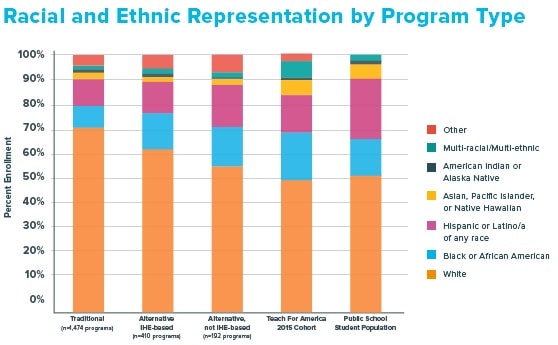
SOURCE: 2014 U.S. Department of Education, Higher Education Act Title II State Report Card System (AY 2012-13 data)
SOURCE: 2015-16 Teach For America Official Statistics Report “Corps Size & Demographics: 2015-16”
SOURCE: 2012-13 U.S. Department of Education, National Center for Education Statistics, Common Core of Data

As a possible solution to the diversity of the classrooms we can read the following excerpt from the article "Student Diversity, TFA, And The Teaching Workforce: What The Numbers Tell Us":

        "TFA is committed to dramatically increasing the diversity of America’s teacher workforce across multiple dimensions. We work to recruit accomplished individuals with a variety of backgrounds and experiences, including teachers with STEM expertise, LGBTQ teachers, military veteran teachers, teachers of color, and teachers with Deferred Action for Childhood Arrivals status."

In this article the Association of Teachers for America analyzes the diversity in US public schools, and as we can read above, to deal with the diversity in schools districts decided to start hiring teachers that belong to this diversity too.


What are the challenges in U.Ed.?

In the article Urban Education: The State of Urban Schooling at the Start of the 21st Century by the The Haberman Educational Foundation we have a list of its challenges:

1. Highly Politicized School Boards
Board politics in major urban school districts often impede judicious decision-making (Ortiz, 1991) Two practices are particularly dysfunctional. First, in an effort to better represent diverse constituencies, citywide board seats have given way to narrowly drawn district seats. Board members elected from such districts may find it difficult to support policies and budgets aimed at the good of the total district when doing so is viewed negatively by parents, citizens and educators in their own neighborhood schools. Second, board members too frequently try to micromanage large, complicated school organizations thereby abrogating the leadership and accountability of their own superintendent. Finally, it is not unusual for narrow majorities on boards to change after a board election and for a superintendent to find his/her initiatives no longer supported and even have his/her contract bought out.

2. Superintendent Turnover
The average years of service for an urban superintendent are 2 and 1/3yrs. (Urban Indicator, 2000). As a result a new superintendent may function more as a temporary employee of a school board than as the educational leader of the district and the community. Administrators and teachers are reluctant to throw themselves into new initiatives that are not likely to remain in place long enough to show any results. Constituencies (governments, businesses, church groups, foundations, universities, etc.) with whom the superintendent must interact may take a wait and see attitude rather than become active partners in the new superintendent’s initiatives.

3. Principals as Managers and Leaders. 
The size and complexity of most urban schools inevitably lead to a focus on the principal as the manager or CEO of a major business enterprise. This emphasis has led to a transformation of the traditional principal role as an instructional leader. (Haberman, 2001) Few urban districts dismiss principals because of low student achievement unless the achievement falls low enough for the school to be taken over by the state or district and be reconstituted. In practice the typical urban principal who is transferred or coaxed into retirement is one that has “lost control of the building.” The district’s stated system of accountability may place student learning as the highest priority but the real basis for defining urban principals as “failing” is not because they have been unable to demonstrate increasing student achievement but because they have been unable to maintain a custodial institution. The fact that most urban principals spend the preponderance of their time and energy on management issues demonstrates that they fully understand this reality. (Kimball & Sirotnik, 2000)

4. Government Oversight. 
Local and state government officials involve themselves more and more in educational policies that impact urban districts. This politicization of education produces an endless stream of regulations and funding mechanisms, which encourage or penalize the efforts of local urban districts. Like an overmedicated patient the treatments frequently counteract one another or have unintended negative consequences.

5. Central Office Bureaucracies. 
In rural, small town and suburban districts, classroom teachers comprise 80% or more of the school district’s employees. In the 120 largest urban districts the number of employees other than teachers is approaching a ratio of almost 2:1; that is, for every classroom teacher there are almost two others employed in the district ostensibly to perform services which would help these teachers. (Knott & Miller, 1987) The effect of this distortion is frequently a proliferation of procedures, regulations, interruptions and paperwork that impedes rather than facilitates student learning. Many teachers leaving urban districts cite paperwork and bureaucratic over regulation as among the most debilitating conditions they face.

The self-serving nature of the district bureaucracy frequently impedes initiatives, which would decentralize decision making and transfer power to individual school staffs. (McClafferty, 2000) Historically centralized systems are reluctant to change. Prodded by parents, community and business leaders, urban districts are gradually allowing more decentralized decision making at the school level. In response to bureaucratic rigidities choices are proliferating within public systems. Examples include open enrollment plans, magnet and specialty schools, schools-within-schools, alternative schools, and public choice and charter schools. Urban parents also have increased options outside the public systems through private school voucher programs but these efforts account for less than one percent of enrollment in urban districts. (Hill, 1999)

6. School Staff Accountability. 
As public school options increase so do calls for accountability. The most frequently tried accountability efforts in the last century have been attempts at merit pay for teachers based on student achievement test scores. Many of these trials have been funded by private foundations and several have been supported initially by local teachers unions. Thus far, however, there have been no successful models for holding either principals or teachers accountable based on achievement scores. (Ross, 1994) In some cases superintendents have clauses in their contracts stating that their tenure or salaries are dependent on improvements in student achievement. In some districts school principals’ annual evaluations and contract extensions are now tied to improving student achievement. Currently, many states have adopted systems for declaring particular schools (or districts) as failing if a given number of the school’s students are below a minimum level of achievement. In these cases the state may mandate that a failing school be reconstituted and may grant the local district the authority to re-staff the school with a new principal and teaching staff. (Crosby, 1999) The staff of a failing school is typically permitted to transfer to other schools in the district. This means that while an urban school district is being held accountable based on achievement data the individual staff members are not. Furthermore the concept of accountability is non-existent for curriculum specialists, hiring officials, or those who appoint principals, psychologists, safety aides or other school staff.

7. Teacher Shortages. 
The public clearly understand the importance of well-prepared teachers: 82% believe that the “recruitment and retention of better teachers is the most important measure for improving public schools, more effective than investing in computers or smaller class size.” (Education Commission of the States, 2000) In the next decade there may be as many as 1 million new teachers hired because of turnover, retirement and the fact that the typical teaching career has shortened to approximately 11 years. (Langdon & Vesper, 2000) If the school age population continues to increase, another million teachers may be needed. While all districts face occasional selected shortages of special education teachers, bilingual teachers, math or science teachers, the major impact of the current and continuing teacher shortage falls on the urban school districts. These are the teaching positions that many traditionally prepared teachers are unwilling to take. This problem is confounded by the fact that many urban districts must lay off teachers to make up for budget deficits in a given year while they are simultaneously recruiting teachers to remedy their chronic shortages. (Reid, 2002)

In the states that prepare a majority of the teachers in traditional university based programs more than half of those who graduate and are certified never take teaching positions. (Schug, 1997) “ One third of new teachers leave the profession within five years.” (Education Commission of the States, 2000) The typical teacher education graduate is a 22-year-old white female, monolingual with little work or life experience. She will teach within fifty miles of where she herself attended school. The profile of teachers who succeed and stay in urban school districts differs in important respects. (Sprinthall, 1996) While they are still predominantly women, they are over 30 years of age, attended urban schools themselves, completed a bachelor’s degree in college but not necessarily in education, worked at other full-time jobs and are parents themselves. This successful pool also contains a substantially higher number of individuals who are African American, Latino and male. Typically, the teacher educators who serve as faculty in traditional university-based teacher preparation programs have had little or no teaching experience in urban school districts while those mentoring teachers in alternative licensure programs typically come from long, successful careers as teachers in urban districts.

8. State Licensure Laws. 
While traditional teacher preparation programs seek to attract more young people into the teaching profession, past experience suggests that many of these graduates will not seek employment in large urban school districts where most of the new hires will be needed. (Schug 1997) To assist in meeting this urban district need, new kinds of recruiting and training programs are being established to attract older, more experienced and more diverse candidates into the teaching profession. States differ widely in their response to these new programs. “Conventional wisdom holds that the key to attracting better teachers is to regulate entry into the classroom ever more tightly…” while others argue that “the surest route to quality is to widen the entryway, deregulate the processes, and hold people accountable for their results…” (Thomas B. Fordham Foundation, 1999) Forty-three states have passed alternative licensure laws which permit the hiring of college graduates who were not trained in traditional programs of teacher preparation. But licensure requirements vary greatly across the states and implementation of new approaches is often controversial even though an increasing number of urban districts now “grow their own” teachers using alternative training programs. (Feistritzer, 1993)

9. Funding for Districts and Classrooms. 
Students in urban school districts often have substantially less annual per student support than they need. The level of support in urban districts, however, generally exceeds the per pupil expenditures in small towns and rural areas. Many argue, therefore, that in total there is no shortage of funds for urban schools especially when categorical aids and grants are considered. The overall problem of inadequate funding is often exacerbated after the urban school district receives its funds and distributes the monies from the central office levels to the individual schools. Too often too many funds are expended to maintain central office functions leaving too little to cover the direct costs of instruction and equipment in specific school buildings. In addition, many urban districts are characterized by buildings that are outmoded, even unsafe, creating conditions which make learning problematic. New York City, for example, has over 150 buildings still heated by coal.

10. Projectitis. 
New school board members and superintendents often believe they must set their personal stamps on the district through new initiatives. It is common for urban districts to claim they are aware of and experimenting with the latest curricula in reading, math, science, etc. (Schuttloffel, 2000). In addition, administrators are pressured to try out new programs against drugs, violence, gangs, smoking, sex, etc. This proliferation of programs and projects results in so many new initiatives being tried simultaneously it is not possible to know which initiative caused what results. Furthermore, not enough time is devoted to the program to give it sufficient time to demonstrate intended results. The problem is compounded by the fact that many of these new initiatives are not systematically or carefully evaluated. Veteran teachers, when confronted with the latest initiative from the school board or administration, typically become passive resistors. “This too shall pass.” The constant claims of experts, school boards and superintendents that their latest initiative will transform their schools is frequently stonewalled by the very people who must be the heart of the effort for it to succeed. (Van Dunk, 1999)

11. Narrowing Curriculum and Lowering Expectations. 
As presented in state and local district philosophy and mission statements the list of what the American people generally expect from their public schools is impressive. A typical list is likely to include the following goals for students: basic skills; motivated life long learners; positive self concept; humane, democratic values; active citizens; success in higher education and in the world of work; effective functioning in a culturally diverse society and a global economy; technological competence; development of individual talents; maintenance of physical and emotional health; appreciation and participation in the arts. In many suburban and small town schools the parents, community and professional school educators maintain a broad general vision about the goals that 13 years of full time schooling is supposed to accomplish. But in the urban districts serving culturally diverse students in poverty these broad missions are frequently narrowed down to “getting a job and staying out of jail.” (Russell, 1986)

Narrowing down the curriculum is particularly evident among the burgeoning populations of students labeled as special or exceptional. The urban districts have disproportionately large and wildly accelerating numbers of students labeled with some form of disability. In urban districts the numbers of special students currently range from 6% to 20% of the student body. This means that exceptional education may account for between 20 and 35% of a total urban district’s budget. Well intentioned but sometimes misapplied state and federal initiatives for special education students encourage the labeling of increasing numbers of students as learning disabled, cognitively disabled or having attention deficit hyperactivity disorder. (Breggin & Breggin, 1994) It is not uncommon for many urban teachers who do not have in depth knowledge of child development to perceive undesirable behavior as abnormal rather than as a temporary stage or as student responses to poor teaching. Thus it is common in urban middle schools to find many students doing well academically who have been labeled as disabled in primary grades and who will carry these labels throughout the remainder of their school careers. Teacher expectations are likely to be very modest for such children; testing may be waived. Some low-income parents may be enticed to agree to have their children labeled exceptional because of financial grants. Recent efforts at inclusion for exceptional students in regular classrooms are aimed at breaking the cycle of low expectations and isolation. In urban districts, however, inclusion mandates are most frequently followed in the primary grades but seldom at the high school level. (Cohen, 2001) The disproportionate number of children of color, particularly males, labeled exceptional further exacerbates this problem.

12. Achievement and Testing. 
There are four curricula operating in schools. The first is the broadest. It is the written mission of the school district. The second curriculum is what the teachers actually teach. The third operative curriculum is what the students actually learn which is considerably less than what the district claims or what the teachers teach. The fourth curriculum is what is tested for and this is the narrowest of the four. The tested for curriculum frequently supports the narrowing and lowering of expectations. (D’Amico, 1985) As total school and district programs are evaluated by norm referenced tests the accountability of teachers and principals is also narrowed and lowered to the kinds of learning that can be readily tested. Recognition of this problem has led to a new emphasis on standards-led testing or performance assessment closely linked to curriculum in place of the norm reference testing that compares student’s performance to that of others. Done carefully, such assessment measures the performance of successive cohorts of students against an annual rate of improvement (local or state) that is sufficient to achieve whatever curriculum goals have been set. (Education Commission of the States , 1997) For the most part, aligning the goals, curriculum, instruction and testing is yet to be accomplished.


The Haberman Educational Foundation in its article shows a detailed information about the characteristics of the U.Ed. students and their characteristics as well as a huge list of references.

Urban Education and Movies

Looking for information in the world-known browser "google", I´ve found something really interesting: one article that talks about the urban movies whose common denominator is how their characters, urban teenagers, struggle in unstable environments.

One of my favorite is "Dangerous Minds" with an excellent sound track.


What´s your favorite movie? You can choose your movie clicking here.


Now that I´m talking about that movie set in the mid 1990s, another thing caught my attention. If all those problems were already happening in that period, what has changed? So, again back to google and I try to look more information about U.Ed. and found this interesting article A New Era in Urban Education? where we can read many characteristics of the schools and students of that period that are still happening 20 years later. Those issues that are present in our schools are the challenges to deal with low-income students and families, but there was a new topic: "charter schools" that according to the ideas of the year of the article (1998) these schools would give an answer to their problems. I don't want to go on talking about charter schools because it´s a topic that we will deal with during our second session. Be patient!


References and articles


  • http://www.right-to-education.org/page/understanding-education-right
  • https://learningandurbaneducation.wordpress.com/
  • https://nces.ed.gov


Research on Parent Engagement

Research: Parent Engagement in School Communities


This is my post where we´ll be sharing my information about parent engagement. This information will be updated according to the new information we´ll be acquiring and finding, above all from public schools.


Introduction: Parents, educators, administrators and students in school communities.

It´s well known that the educational process begins in the family, at least this is what most of us think, and continues in school. All this process needs both parties to achieve full development. The school must be clear about the importance of the participation and collaboration of parents in the education of their children as well as the need for an open relationship to perform their function in a complete manner. Sometimes the role of the parents can be confused with that of the teachers, and it is noted that not all parents and teachers have the same educational goals.

WHAT is Parent Engangement?

There are parents who feel comfortable in school, have trusting relationships with teachers, and there are others who approach the school less confident and disoriented. There are some educators who are somewhat afraid of the interview because they feel none.

Both parents and teachers, or in other words, both the family and the school have partly common and partly complementary roles. The roles of the school are related to pedagogical learning, teachers choose the most beneficial pedagogical method, content, goals,... for their students.

The roles of parents cover more, they are the first educators but not the only ones. It is true that parents know their children and know how is their temperament, their reactions and emotions. Therefore, it is essential that the teacher listen to the parents, take into account their situation and know their family reality to be able to reach the student's process, just as the good doctor is right in his diagnosis when the patient gives him the data that they personalize and transform the patient in person.


WHERE and WHEN?

Parent engagement can be done in many ways. Most of the parents have jobs and other responsibilities that impedes them to be present in school during instruction time. However, current schools have a flexible schedule that is not fixed only during the "mornings". Most schools have "afterschool" activities and other events programmed by the same school or other institutions or associations linked to the school. Therefore, parents can find a place and a time to participate with their children.

Home is another place where parents can colaborate from, as well, by offering their help and support in many ways. There are some programs like HIPPY in HISD who offer home support for Early Childhood students in the district.


Figure 1: HISD Participation from their Memorandum in 2017.

WHY? 

Why is too important to colaborate with parents and educators?  It would be a disaster for those who do not have to know the pedagogy and methodology of the sciences or other school subjects to do the programming of it/them. It would be unfortunate that those who are going to improve our health, prescribe what is best for us with no knowledge of health or having a degree as a physician. Parents and teachers are the two pilars that welcome, encourage, help, accompany our students and support them during their successful lives, both of them are indispensable in this amazing vital journey.

Figure 2: English Language and Literacy CIRCLE subtests 2017 from Memorandum in 2017.

Figure 2: Spanish Language and Literacy CIRCLE subtests 2017 from Memorandum in 2017.

These figures show the results when combining parents and teachers´colaboration in the Houston Independent School District with the HIPPY program for their young students. As a former HISD Dual-Language PreK teacher in the district I was a witness of the success of this program involving parents in their children´s education, especially among Latino families.

How?


Here you can find several recommendations and suggestions that we believe can help you, as parents, and your children, our students, since we share the same vision: their success in life through education.  We are convinced that participation is the most appropriate way for teachers and families to validate their competence as parents and teachers mutually.

The allowance of participations is complex but we can find help and support in your school. Most districts provide a "FACE" (Family and Community Empowerment) worker who can help you with all this process. There are many papers and documents to fill in and do some registrations. Be patient, please! All this task is for the safety of our students, staff and other school community members. We recommend you to be informed in your school as soon as the school year begins, since all this process can last for several weeks or even one month´s time in some cases.

After being admitted and approved, visit your assigned counselor or FACE worker to introduce you to the activities and other institutions/associations participating in the school community. Parental involvement is an important factor in their academic success. Most schools have PTO or PTA  that can help you as well with your active participation in schools.

Communication and values: improving our relationships in school communities.

School-to-Home Communication Infographic


Communication is going to be the base of the succesful academic performances of our students. This communication should be based on a daily interaction with students-parents-educators, because all of them are responsible for the success of their process of education and lives.

The improvement of communication processes between parents and teachers is probably one of the greatest needs that our educational system has. The benefits it brings to the students as well as to the teachers and parents. The parents, through their active participation, get involved with the teachers´ tasks, discover that they are really important in the education of their children; they can feel more comfortable communicating with teachers, discover how their children work at school and, finally, parents acquire skills that help them to take advantage of tutoring with teachers.

By involving parents, it is possible for teachers to gain a greater understanding of the difficulties that prevent parents from getting involved in their children's education and, from this understanding, they learn strategies on how to reach all parents effectively, such as active listening, understanding of defensive behaviors and conflict resolution.

Teachers feel less isolated and schools are encouraged to develop activities that encourage very varied forms of parental involvement. The children-students discover the shared vision expressed by teachers and parents. The children-students do not use the information they transmit to their parents and teachers in a biased way.

However... after agreeing that participation is very beneficial, why is it so hard to carry it out? Why do some parents and teachers perceive each other as a source of conflict, rather than as a source of help?


https://i.ytimg.com/vi/Qawp93xyQJI/maxresdefault.jpg

First, we must bear in mind that participation involves communication and this is a source of conflict too, that is, when a person, whether a father, a mother, teacher,... expose their ideas, necessarily they are confronted with the ideas the others have. And we usually have a tendency to interpret communicative conflicts as a "problem", and not as a starting point to put together (parents and teachers) our possibilities to respond to the demands of our children, our students.

Secondly, for participation to take place it is necessary that parents and teachers have a feeling of belonging to an educational community (being a part), but to participate, it is also necessary to be aware of the rights and duties that parents and teachers have and also to be aware that the benefits and costs are shared (having part) and, finally, we must be able to develop motivation for the development of specific activities (take part).

Third, we must bear in mind that, in the communicative process, we see and hear in a selective way based on our needs, motivations, experiences, interests, personal expectations, education and other personal characteristics. And this way of perceiving reality is different in parents and teachers, and that is why it can generate conflicts.

Fourth, communication between parents and teachers has an important emotional burden: let's not forget that children are the most important people for their parents.

If we do the same things as before, we will get the same results. Einstein.

I would like to conclude by reaffirming that the teachers are doing an exceptional task to respond to the needs of their students, that parents are willing to do "whatever" for their children, and that we need each other, we need to be able to establish mutual commitments that benefit our children, we need to be able to validate each other as what we are: teachers and parents. So go for the FACE/PTO/PTA member of the school and participate, it's never too late!


Educational celebration is given when those hands come together and celebrate. 


Other related articles and information:

  • http://www.pewsocialtrends.org/2015/12/17/parenting-in-america/
  • http://blogs.houstonisd.org/news/2017/06/06/hisd-face-is-now-the-family-and-community-empowerment-department/
  • http://www.pto.org/
  • https://www.pta.org/
  • http://www.faces-cares.org/
  • http://neatoday.org/
  • https://parents4publicschools.org/
  • http://blogs.longwood.edu/parentinvolvement/
  • https://peopleforeducation.ca/topics/parent-involvement/
  • https://tomorrow.org/speakup/speakup-2016-school-to-home-communications-september-2017.html

by
Dr. Nicole Andews
Dr. Neelu Tajani
A.R. Ms. Xuan Li
A. R. Mr. Francisco Usero Gonzalez